
Icebreaker Games
One game per card, explained in a sentence, so a room of new faces can start playing in under a minute.
- Time
- 5–30 min
- Players
- Four or more people
- Best for
- Team meetings, workshops and meetups
- Deck
- 100 games in 5 categories
How to use these icebreaker games
- Pick a category that suits the room from the menu under the card, or keep “All categories”.
- Read the game on the top card aloud, then play one round of it with the whole group.
- Swipe the card away, or tap “Next game”, for another. Games do not repeat until you have seen the whole category.
- Tap the heart to save a game on this device, or tap “Make a 10-game list” for a plan to paste into a meeting agenda.


When to play icebreaker games
A group of people who have just met tends to wait for someone else to speak first. A game with one simple rule gives everyone something to do with their hands and their attention, and the talking follows.
The first week of a new team
Get-to-know-you games like People bingo and Partner interview put names to faces faster than a round of job titles, and Group résumé shows what the team can do together.
A meetup or club night
Guessing games suit a room of strangers. Mystery sound or Price guess gets everyone calling out answers, and nobody has to talk about themselves until they want to.
A family reunion of grown-ups
Relatives who see each other once a year can split into mixed teams for Paper tower or Alphabet race, so cousins and in-laws end up on the same side.
Ways to run icebreaker games
A five-minute meeting opener
Draw one card from Quick openers before the first agenda item and play a single round. Games like Fist to five or Hum that tune need no supplies and are over in a few minutes, so the meeting still starts on time.
A warm-up, then teams
At a workshop or an offsite, start with a mixer from Get-to-know-you games so people meet a few faces, then split into teams and draw from Teams and small groups. Paper, tape and a timer cover most of those cards.
A game for every video call
For a team that meets on camera, make a 10-game list from Video call games and paste it into the shared agenda. Open each call with the next game on the list, from Chat waterfall to Spot the change.
Tips for icebreaker games that work
- Read the card aloud, then play one practice turn yourself before the room starts, so nobody has to ask how it works.
- Keep every game optional. Anyone can watch, keep score or hold the timer instead, and that counts as playing.
- Mix the groups each round in team games, so people meet someone new instead of staying beside the colleague they arrived with.
All 100 icebreaker games by category
The complete list, grouped by category. The cards above draw from the same list, so you can read ahead here and pick there.
Quick openers
Five-minute games for the start of a meeting, like a silent line-up, a one-word round or a weather report for your week.
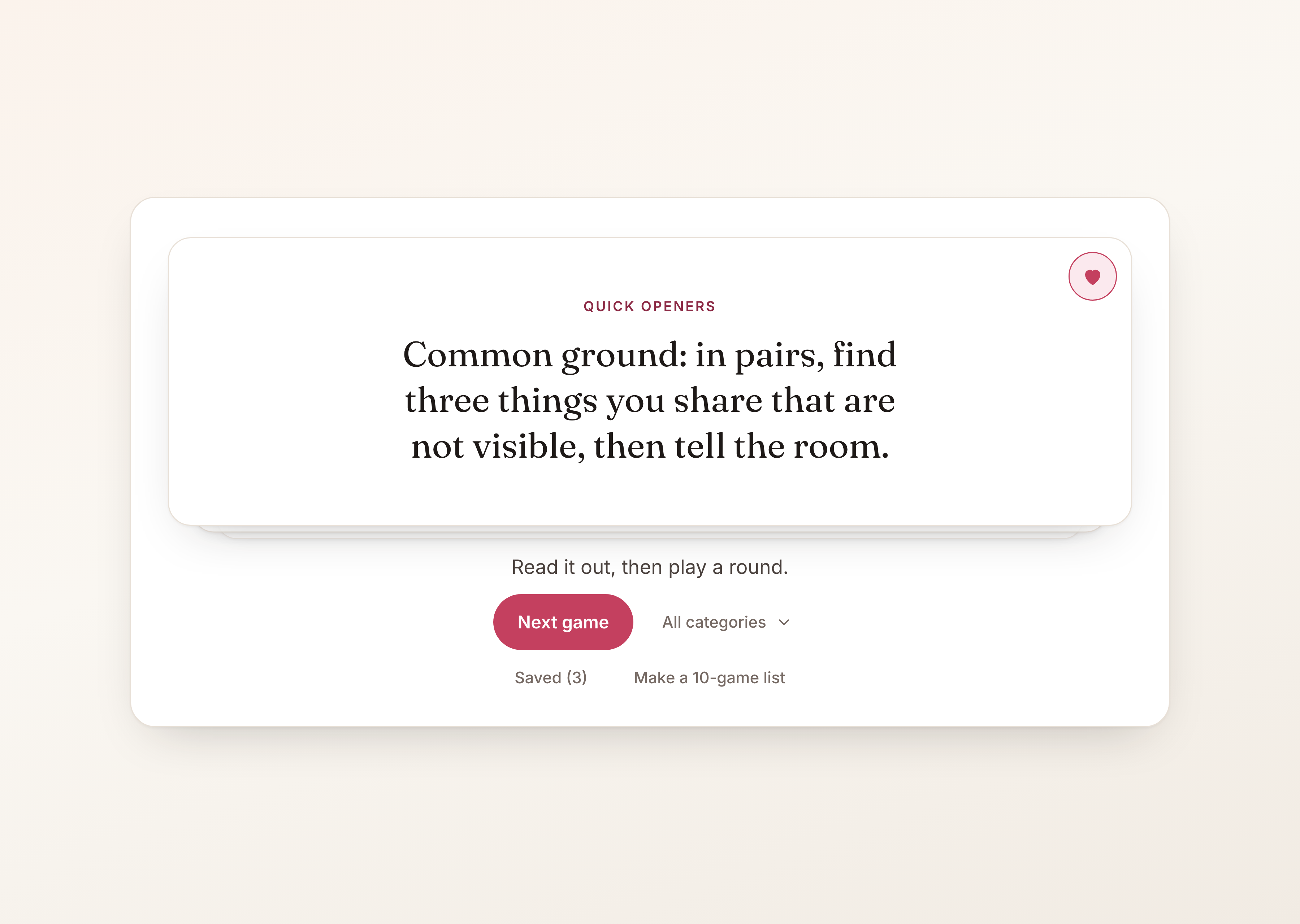
- Common ground: in pairs, find three things you share that are not visible, then tell the room.
- One-word round: the host names a topic, like summer, and everyone adds one word without repeating anyone else’s.
- Silent birthday line-up: line up by birthday month and day using only hand signals, then say the dates aloud to check.
- Name and snack: say your first name with a snack that starts with the same letter, like Maya and mango.
- Show of hands: the host calls out two choices, like beach or mountains, and everyone raises a hand for one.
- Stand up if: the host reads lines like “has baked bread this year”, and anyone they fit stands up briefly.
- Ten-second sketch: everyone draws the same word, like bicycle, in ten seconds, then all hold up their drawings at once.
- Count to twenty: the group counts aloud one voice at a time, in no set order, restarting whenever two speak together.
Show all 20 in Quick openersShow fewer
- Fist to five: the host names a food, and everyone shows zero to five fingers for how much they like it.
- Desk object story: pick up one object within reach and tell the room the short story of how you got it.
- Three-word intro: introduce yourself in exactly three words, and the room asks you one follow-up question.
- Rock, paper, scissors crowd: whoever wins each pair gains the other as a cheering fan, until two big crowds face off.
- Speed intros: each person gets thirty seconds on a phone timer to say who they are, and stops at the beep.
- Letter chain: each person says a word starting with the last letter of the word before, like apple, egg, garden.
- Sentence story: tell a story one sentence each, starting from “On Monday morning, a goose walked into the office.”
- Clap it back: one person claps a short rhythm, and the whole room claps it back together.
- Name and gesture: say your name with a small gesture, and the room repeats every name and gesture so far.
- Odd one out: the host names four things, like apple, pear, carrot and plum, and everyone calls out the misfit.
- Mirror hands: in pairs, one person moves their hands slowly while the other mirrors them, then switch after thirty seconds.
- Weather report: each person names the weather that matches their week, like sunny spells or light drizzle, and says why.
Get-to-know-you games
Mixers that let new people learn a little about each other, from people bingo to a partner interview.
- People bingo: each square names a trait, like “speaks two languages”, and you find a different person for each square.
- Two truths and a lie: each person says three short facts about themselves, and the room votes on the made-up one.
- Partner interview: in pairs, interview each other for two minutes, then introduce your partner to the room.
- Shared and unique: in groups of four, find one thing you all share and one thing only each person has.
- Speed chats: sit in two facing rows, chat for two minutes on one prompt, then one row shifts a seat.
- Map pins: everyone marks a favorite place on a big paper map, then says one line about why.
- Four corners: label the corners beach, city, mountains and home, then everyone walks to one and chats with that group.
- Paper snowballs: write a light question on paper, crumple it, toss it into the middle, then answer one you pick up.
Show all 20 in Get-to-know-you gamesShow fewer
- Favorites grid: in pairs, fill a grid of favorites, like song, snack and season, circling matches and starring surprises.
- Yarn web: hold the end and toss the yarn across the circle, sharing one thing you learned about the catcher.
- Group résumé: each small group writes one shared résumé listing every skill, job and hobby, then reads it aloud.
- Firsts swap: share a harmless first, like your first job or first concert, and anyone with a similar one raises a hand.
- Find your match: everyone gets half of a famous pair, like salt or pepper, finds the other half and chats.
- Name story: share the story behind your first name or a nickname in under thirty seconds.
- Hot seat: one volunteer answers quick, light questions from the room for one minute, and can pass on any of them.
- Tip swap: write a small everyday tip on a slip, trade slips twice, then read the one you hold aloud.
- Name tag clues: add three hobby words under your name on a name tag, then mingle and ask about others’ words.
- Personal flag: draw a simple flag with three symbols for things you enjoy, then explain it in thirty seconds.
- Question mingle: each person gets a question card, asks three people, then swaps cards with the last person they asked.
- Word wall: the host writes twenty words on the board, and each person picks one that fits them and says why.
Guessing games
The room works out a hidden answer, like a secret word, a mystery sound or who wrote a fact.
- Mystery facts: everyone writes a little-known fact about themselves, the host reads them out, and the room guesses the writer.
- Not this, not that: describe an object only by what it is not, like not round and not edible, until someone names it.
- Shadow puppets: one person makes a hand shadow on the wall, and the room guesses the animal.
- Pocket object: describe something from your pocket or bag by shape, color and size only, and the room guesses it.
- Air drawing: one person draws a simple object in the air with a finger, and the room guesses it.
- Draw and guess: one person draws a word on a whiteboard with no letters or numbers, and the room has one minute.
- Forbidden words: describe a word to the room without saying it or any of three words the host has banned.
- Jar guess: fill a jar with paper clips, everyone writes a guess, and the closest guess picks the next game.
Show all 20 in Guessing gamesShow fewer
- Whose desk: the host describes three things on someone’s desk, and the room guesses whose desk it is.
- Emoji weekend: each person writes their weekend as three emojis on the board, and the room guesses what they did.
- Book cover clues: describe what the cover of a famous book shows, and the room names the book.
- Which way: the host names a far-off city, everyone points to where they think it lies, then the host checks a map.
- Secret word: the host gives each person a secret word to slip into conversation, and the room tries to catch it.
- Hobby clues: describe someone in the room by their hobbies only, and the others guess who it is.
- Price guess: the host holds up a grocery item, everyone writes a price, and the closest guess picks the next item.
- Feel and guess: pass a cloth bag with one object inside, and everyone feels it through the cloth before guessing.
- Missing letters: one person writes dashes for a word on the board, and the room calls out letters until it is solved.
- Hidden link: name items, like apple, fire truck and rose, until someone guesses the link, which here is red things.
- Finish the saying: the host starts a common saying, like “the early bird”, and the room calls out the rest.
- Guess the voice: one person faces away while another says “good morning” in a disguised voice, then they guess who.
Teams and small groups
Games for groups of three to six, from paper towers and code breaking to a sixty-second product pitch.
- Paper tower: each team builds the tallest freestanding tower it can from twenty sheets of paper and tape in ten minutes.
- Scavenger hunt: each team gets a list, like something blue or a round sign, and photographs each find nearby.
- Charades round: one team member acts out a word without a sound, and the team has one minute to guess.
- Island ranking: each team ranks ten items to bring to a desert island, then teams compare their lists.
- Line by line: team members add one line each to a shared drawing, then the room guesses what it became.
- Swap quiz: each team writes five quiz questions, then teams trade sheets and answer each other’s.
- Five-word story: each team gets five random words and has five minutes to write a short story using all of them.
- Back-to-back drawing: one partner describes a simple picture while the other, facing away, draws it, then compare.
Show all 20 in Teams and small groupsShow fewer
- Team crest: each new team picks a name and draws a crest in five minutes, then presents it to the room.
- Puzzle swap: mix a few pieces from each team’s jigsaw into other teams’ boxes, so they must trade to finish.
- Alphabet race: teams write one food for each letter of the alphabet, A to Z, in five minutes.
- Pitch it: teams invent a silly product, like a self-folding umbrella, and pitch it to the room in sixty seconds.
- Slogan swap: each team writes a slogan for another team’s favorite snack, then the room votes on the catchiest.
- Puzzling situation: the host describes an odd scene, and teams ask yes-or-no questions until they can explain how it happened.
- Team playlist: each team builds a five-song playlist, one pick per member, then plays ten seconds of each.
- Code breaker: teams race to decode a short message written in a simple code, like A equals 1.
- Cup stack: teams build a cup pyramid using a rubber band tied to strings, with no hands touching the cups.
- Story fold: each person writes one sentence, folds the paper so only that line shows, and passes it on.
- Paper bridge: each team builds a paper bridge between two books that holds as many coins as possible.
- Map from memory: each team draws a map of the neighborhood from memory, then compares it with a real map.
Video call games
Games that work on camera and in the chat, like call bingo, lip reading and a typed waterfall.
- Show me five: the host reads five items, like something striped, and everyone shows each on camera as fast as possible.
- Close-up photo: share a zoomed-in photo of an everyday object, and the first to name it in the chat shares next.
- Chat waterfall: the host asks a question, everyone types an answer without sending, then all press enter on three.
- Whiteboard jam: everyone draws on one shared whiteboard for two minutes, then the group gives the picture a title.
- Screen name clue: add one word about your weekend after your screen name, and others ask about it in turn.
- Lip reading: one person mutes and says a short phrase, and the others guess it from their lips.
- Breakout riddles: each breakout room solves the same riddle, and the first room back posts the answer in the chat.
- Call bingo: everyone gets a bingo card of call moments, like “a pet walks by”, and marks squares as they happen.
Show all 20 in Video call gamesShow fewer
- Draw it blind: everyone closes their eyes and draws a house on paper in thirty seconds, then shows it on camera.
- Follow the leader: one person makes a gesture on camera, the next repeats it and adds one, and the chain grows.
- Where in the world: share a street-level photo of a place you have visited, and the group guesses the city.
- Vote in chat: the host posts two options, everyone types A or B, then one person from each side says why.
- Chat trivia: the host asks five quick trivia questions, and everyone sends answers privately to the host.
- Fast fingers: everyone types the same short sentence into the chat, and the first exact copy picks the next sentence.
- Spot the change: everyone looks away while one person changes something in their frame, then the group guesses what moved.
- Longest word: the host posts seven random letters, and everyone has one minute to type the longest word they can make.
- Leader says: the leader calls out seated moves like wave or nod, and everyone follows only when it starts “leader says”.
- Desk detective: one person shows their desk for five seconds, turns the camera away, and others list what they saw.
- Chat jinx: on three, everyone types one word for a prompt like breakfast, and matching words get a round of applause.
- Pass the mic: each person answers a light question in ten seconds, then names who answers next.
Frequently asked questions
How many icebreaker games are there?
There are 100 icebreaker games, 20 in each of five categories: quick openers, get-to-know-you games, guessing games, teams and small groups, and video call games. The cards and the list on this page use the same set.
What is the difference between icebreaker games and icebreaker questions?
A question is something everyone answers in turn. A game has a rule, like lining up in silence or guessing a hidden word, and often a small goal. For prompts to go around the room with, see icebreaker questions. Many games here, like Question mingle or Pass the mic, work with any of those questions.
Which icebreaker games work best for work teams?
For a short meeting, Quick openers and Guessing games take five minutes and need no supplies. For a new team, Partner interview, People bingo and Group résumé help people learn names and skills. Two truths and a lie is a classic too, and two truths and a lie ideas gives sample statements for anyone stuck.
What should we play after icebreaker games?
Once the room is warm, try a longer round of charades ideas, with words to act out sorted from easy to hard. For a quieter group, riddles work at a table or on a call, and the answer is one tap away.