Fun Facts
One surprising, true fact on the card, read out loud to a room that didn’t know it either.
- Time
- 1–15 min
- Players
- One or more people
- Best for
- Team chats, dinners and long drives
- Deck
- 150 facts in 6 categories
How to use these fun facts
- Pick a category from the menu under the card, or keep “All categories”.
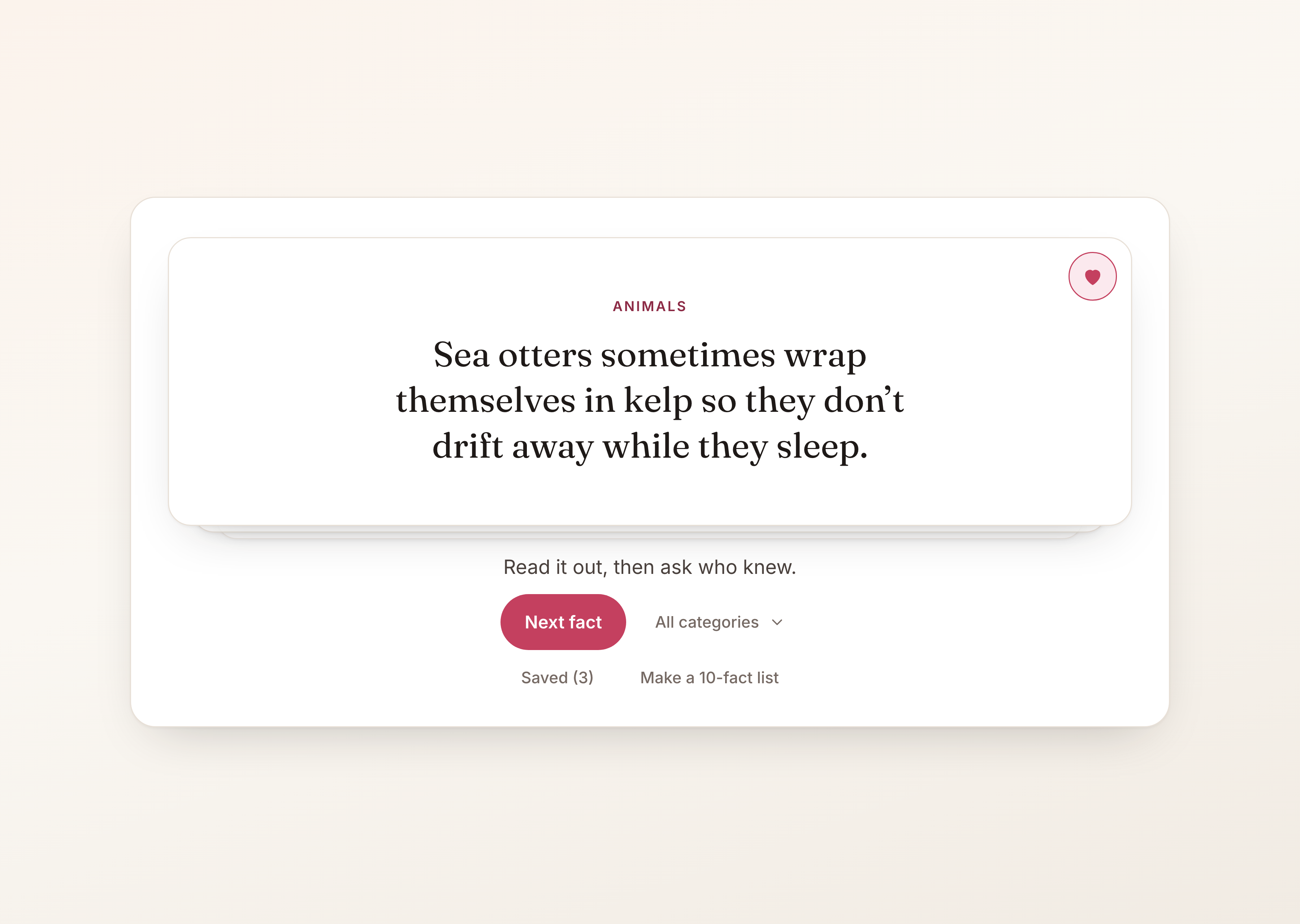
- Read the fact on the top card out loud, then ask who already knew it.
- Swipe the card away, or tap “Next fact”, for another. Facts do not repeat until you have seen the whole category.
- Tap the heart to save a fact on this device, or tap “Make a 10-fact list” for a list to post or read from later.


When to share a fun fact
A good fact takes ten seconds to read and leaves everyone with something to say, so it fits into a coffee break, a chat thread or a lull in conversation. Each card is a single true fact, so there is nothing to prepare and nothing to check.
A coffee break
Hand the phone across the table and take turns reading. The human body works well here, with things to try on the spot, like finding your dominant eye.
The team chat in the morning
Post one card a day, like Saturn being less dense than water, and let people reply with a guess at how it works or a fact of their own.
A dinner with friends
Read a card from Food between courses, like the cashew growing on its own apple or nachos being named after a man called Nacho, and see who knew.
Ways to use these fun facts
A fact of the day at work
One person draws a card each morning and posts it in the team chat or reads it at the start of a meeting. Anyone who already knew it says so in one line. Pass the job on each week, and let the new reader pick the category.
True or made-up?
The reader draws a card and, without showing anyone, makes up a second fact about the same thing. They read both aloud in any order, and everyone votes on which one is real. The card is always the real one, so the reader turns the phone around after the vote.
Conversation fuel
When a dinner or a long drive goes quiet, read one card and let it lead somewhere. A fact about octopus blood or the moon drifting away usually brings out a question, a guess or a story of someone’s own.
Tips for sharing a fun fact
- Read the fact as a question first, like “How many bones does a giraffe have in its neck?”, and let people guess before you give the answer.
- Try the ones you can test on the spot. The human body has a few, like humming with your nose pinched shut.
- Pick the category for the room: Space and Nature and Earth suit a road trip, while Food is a natural fit at the table.
All 150 fun facts by category
The complete list, grouped by category. The cards above draw from the same list, so you can read ahead here and pick there.
Animals
Pink flamingos, sleepy koalas, blue-blooded octopuses and butterflies that taste with their feet.
- Flamingos get their pink color from pigments in the tiny shrimp and algae they eat.
- Sea otters sometimes wrap themselves in kelp so they don’t drift away while they sleep.
- An octopus has blue blood, because its blood carries oxygen with copper instead of iron.
- A cow’s stomach has four separate compartments.
- A garden snail’s tongue-like ribbon is covered in thousands of tiny teeth.
- Koalas spend most of the day asleep, often 18 hours or more.
- A giraffe has seven bones in its neck, the same number as a person.
- An owl can’t move its eyes in their sockets, so it turns its whole head instead.
Show all 25 in AnimalsShow fewer
- A sea star has a simple eye at the tip of each arm.
- Butterflies taste with their feet, using sensors that tell them which plants to lay eggs on.
- When a woodpecker pulls in its long tongue, the tongue wraps around the back of its skull.
- Horses can’t breathe through their mouths, only through their noses.
- Cats can’t taste sweetness.
- Algae can grow in a sloth’s fur and give it a greenish tint.
- Honeybees do a waggle dance that tells other bees which way to fly to find flowers.
- The Arctic tern flies from the Arctic to the Antarctic and back every year.
- Snakes flick their tongues to pick up scents from the air.
- Wood frogs can freeze almost solid in winter and hop away when they thaw in spring.
- Cheetahs can’t roar, but they can purr.
- Dolphins can sleep with one half of the brain at a time, while the other half stays alert.
- Goats have rectangular pupils.
- A rabbit’s teeth never stop growing.
- A camel’s hump stores fat, not water.
- Jellyfish have no brain, no heart and no bones.
- A shark’s skeleton is made of cartilage, not bone.
Space
The sun, the moon and the planets, from sunrise on Venus to lakes on Saturn’s moon Titan.
- Sunlight takes about eight minutes to reach Earth.
- Venus spins the opposite way to most planets, so there the sun rises in the west.
- The moon always shows the same face to Earth.
- A day on Mars lasts about 24 hours and 40 minutes.
- Saturn is less dense than water.
- Olympus Mons, a volcano on Mars, is about two and a half times as tall as Mount Everest.
- Sound can’t travel through the near-empty vacuum of space.
- The sun holds more than 99 percent of all the mass in our solar system.
Show all 25 in SpaceShow fewer
- The moon is drifting away from Earth by about an inch and a half a year.
- Halley’s Comet swings past Earth about once every 76 years.
- Venus is the hottest planet, even though Mercury is closer to the sun.
- One year on Neptune lasts about 165 Earth years.
- Pluto was reclassified as a dwarf planet in 2006.
- The moon has quakes, called moonquakes.
- A shooting star isn’t a star but a bit of space rock or dust burning up in our air.
- Astronauts grow slightly taller in space, because their spines stretch out without gravity pressing down.
- Apollo astronauts left mirrors on the moon, and scientists still bounce lasers off them.
- Mars has two small moons, named Phobos and Deimos.
- Neptune was found by math before anyone saw it through a telescope.
- The moon’s gravity is about one sixth of Earth’s, which is why astronauts bounced as they walked.
- The sun is about 400 times wider than the moon and about 400 times farther away.
- Saturn’s moon Titan has lakes and seas of liquid methane and ethane.
- Earth is closest to the sun in early January, not in summer.
- A comet’s tail points away from the sun, so a comet can travel tail first.
- Jupiter spins faster than any other planet: a day there lasts about ten hours.
The human body
Bones, teeth, eyes and muscles, plus a few things you can test on yourself right now.
- The tip of your nose and the outer part of your ears are cartilage, not bone.
- The three smallest bones in your body sit in your middle ear: the hammer, the anvil and the stirrup.
- The thigh bone, or femur, is the longest bone in the human body.
- Fingernails grow faster than toenails.
- An adult heart beats about 100,000 times a day.
- Skin is the largest organ of the human body.
- The tongue map is wrong: every part of the tongue can sense all the basic tastes.
- Try it: you can’t hum with your mouth closed while pinching your nose shut.
Show all 25 in The human bodyShow fewer
- Even identical twins have different fingerprints.
- A full adult set of teeth is 32, counting the four wisdom teeth.
- Tooth enamel is the hardest substance in the human body.
- Each eye has a blind spot where the nerve leaves it, and your brain quietly fills in the gap.
- Goosebumps come from tiny muscles that make each hair on your skin stand up.
- The hyoid bone in your throat is the only bone not joined to another bone.
- You are a little taller in the morning than at bedtime.
- Your left lung is a little smaller than your right, to make room for your heart.
- Your two feet hold 52 bones, about a quarter of all the bones in your body.
- The fastest nerve signals in your body travel at more than 200 miles an hour.
- Most people have a dominant eye, just as they have a dominant hand.
- Pinch your nose while eating a jelly bean and most of its flavor disappears, because flavor depends on smell.
- The DNA in just one of your cells would stretch about six feet if uncoiled.
- Your brain uses about a fifth of your body’s energy.
- The human body has more than 600 muscles.
- Your fingers have no muscles of their own; muscles in your palm and forearm move them with tendons.
- Yawns are catching: seeing someone yawn, or even reading about yawning, can set one off.
Food
Where everyday dishes and ingredients come from, from berries and peppercorns to nachos and Caesar salad.
- To a botanist, a banana is a berry and a strawberry is not.
- Sealed honey keeps for years without spoiling, because it holds so little water.
- A cashew nut grows on the bottom of a fruit called the cashew apple.
- Most green bell peppers are simply picked before they ripen to red, yellow or orange.
- The first cultivated carrots were purple or yellow; orange ones came later.
- Apples float in water because about a quarter of an apple is air.
- White chocolate has no cocoa solids, only cocoa butter, sugar and milk.
- Much of the wasabi served outside Japan is really horseradish colored green.
Show all 25 in FoodShow fewer
- Rice, wheat, corn and oats are all the seeds of grasses.
- Coffee beans are the seeds of a small red fruit called a coffee cherry.
- Nutmeg and mace come from the same fruit: nutmeg is the seed, mace its lacy red covering.
- Black, white and green peppercorns all come from the same plant.
- Cinnamon is the dried inner bark of a tree.
- Fortune cookies became popular in the United States, not in China.
- Caesar salad is named after Caesar Cardini, a restaurant owner, not Julius Caesar.
- Nachos are named after Ignacio “Nacho” Anaya, who first made them in Mexico in the 1940s.
- A nectarine is a kind of peach with smooth skin instead of fuzz.
- Broccoli, cauliflower, cabbage, kale and Brussels sprouts are all forms of one plant species.
- A watermelon is about 92 percent water.
- A raspberry is made of dozens of tiny fruits called drupelets.
- Fresh pineapple stops gelatin from setting, because an enzyme in it breaks the gelatin down.
- Birds can’t feel the heat of chili peppers, so they happily eat them.
- The holes in Swiss cheese are called eyes.
- Apples, pears, cherries and almonds all belong to the rose family.
- Kiwifruit first came from China and was once sold as the Chinese gooseberry.
Words and history
Where robot, OK and daisy came from, plus a few surprising dates from the past.
- The sandwich is named after the 4th Earl of Sandwich, an English nobleman.
- The word “robot” first appeared in a 1920 Czech play, from a Czech word for forced labor.
- The word “muscle” comes from Latin for “little mouse.”
- “The quick brown fox jumps over the lazy dog” uses every letter of the alphabet.
- The # sign has an old nickname: the octothorpe.
- You can type the word “typewriter” using only the top row of letter keys.
- “Strengths” has nine letters and only one vowel.
- Centuries ago, the word “nice” meant foolish.
Show all 25 in Words and historyShow fewer
- “Clue” comes from “clew,” a ball of thread, like one used to find the way out of a maze.
- The abbreviation “lb” for pound comes from the Latin word “libra.”
- “OK” began as a joke abbreviation for “oll korrect” in Boston newspapers in 1839.
- “Hippopotamus” comes from Greek words meaning “river horse.”
- “Dinosaur” comes from Greek words meaning “terrible lizard.”
- “Astronaut” comes from Greek words meaning “star sailor.”
- The daisy got its name from “day’s eye,” because it opens in the morning.
- In English, “pineapple” first meant a pine cone.
- Cleopatra lived closer in time to the moon landing than to the building of the Great Pyramid.
- Teaching at Oxford University began before the Aztecs founded their capital, Tenochtitlan.
- Ada Lovelace published what is often called the first computer program, in 1843.
- July is named after Julius Caesar and August after the Roman emperor Augustus.
- Sunday is named after the sun, Monday after the moon and Saturday after the planet Saturn.
- The “lead” in a pencil is graphite mixed with clay, not the metal lead.
- “Emoji” comes from Japanese words for “picture” and “character,” not from the English “emotion.”
- “Chocolate,” “tomato” and “avocado” all come from Nahuatl, the language of the Aztecs.
- “Shampoo” comes from a Hindi word meaning to press or knead.
Nature and Earth
Lightning, rainbows, ancient pine trees, the tides and what lies deep under your feet.
- A bolt of lightning heats the air around it to about five times hotter than the surface of the sun.
- Count the seconds between lightning and thunder: every five seconds is about a mile away.
- Some kinds of bamboo can grow more than two feet in a single day.
- A rainbow is really a full circle; from the ground, the horizon hides the bottom half.
- Falling raindrops aren’t teardrop-shaped: small ones are round, and bigger ones flatten out like a hamburger bun.
- Tiny ocean plants called phytoplankton make roughly half of the oxygen produced on Earth.
- Oceans cover about 70 percent of Earth’s surface.
- Young sunflowers turn to follow the sun across the sky from east to west.
Show all 25 in Nature and EarthShow fewer
- Venus flytraps grow wild only in a small area of North and South Carolina.
- Some bristlecone pine trees are more than 4,000 years old.
- A single fluffy cumulus cloud can hold water weighing more than a million pounds.
- Earth isn’t a perfect ball: it bulges a little at the equator.
- Earth’s magnetic north and south poles have swapped places many times.
- Water expands when it freezes, which is why ice floats.
- Mushrooms are more closely related to animals than to plants.
- Ocean tides are caused mainly by the pull of the moon.
- Earth’s inner core is about as hot as the surface of the sun.
- Leaves turn yellow and orange in fall because the green fades, showing colors that were there all along.
- A whole grove of quaking aspens can be one single plant, joined underground by its roots.
- Fog is simply a cloud that touches the ground.
- The “ocean” you hear in a seashell is really the sound around you, echoing inside it.
- Coconuts can float across an ocean and still sprout on a far-off beach.
- Pumice is a volcanic rock so full of air bubbles that it can float on water.
- Each bit of fluff on a dandelion clock is a seed with its own tiny parachute.
- The sky looks blue because air scatters blue sunlight more than red.
Frequently asked questions
How many fun facts are there?
There are 150 fun facts, 25 in each of six categories: animals, space, the human body, food, words and history, and nature and Earth. The cards and the list on this page use the same set.
Are these facts really true?
Yes. Each card is a settled fact you can find in a textbook or an encyclopedia, with words like “about” or “most” kept in wherever the plain version would stretch the truth. Popular myths, like the goldfish with a three-second memory, are left out on purpose.
How do you play “true or made-up” with these facts?
One player reads a card and adds a fact of their own invention about the same topic, then reads both in any order. Everyone else votes on the real one. The card is always true, so the made-up one is the player’s. For a version about yourselves, try two truths and a lie.
What should we play after fun facts?
Try trivia questions, where the group answers instead of listening, or the question of the day for one light question everyone can answer in a sentence.